I'm sure everyone has accidentally spoiled a film for someone else they know - my mother revealed the end of "Dial M for Murder" without thinking, and I assume my brother has yet to forgive me for revealing the ending of a film I didn't even see...
However, how about this - you go to the cinema and the film is introduced by a scholar, and it's actually quite an interesting introduction up to the point where said scholar decides to reveal the ending, which as you might imagine was not the most popular move with the audience.
Monday, 6 April 2009

Friday, 3 April 2009
Barbara Stanwyck and why I love her
I envisaged this post a few weeks ago, albeit in a slightly different form. I got the idea for it while watching my third Barbara Stanwyck film of the weekend, Fritz Lang’s “Clash by Night” (1952) – the other two being Robert Siodmark’s “The File on Thelma Johnson” (1950) and Douglas Sirk’s “There’s always Tomorrow” (1956). It was meant to cover all three films, and my general love for the actress. On top of these, in the last few months I had a chance to see “Meet John Doe” again and watch “The Furies” and “You Belong to Me” for the first time (the latter in a Sony release for Portugal and Spain which left a lot to be desired). Sadly have yet to finish “Clash by Night”, so let’s see where this post goes.
If my memory doesn’t betray me, and going through her filmography on IMDb, I’ve seen around 25 of her films, am halfway through two (“East Side, West Side” is the other), have still to watch three I owe and have one more on the way. And there’s still many more I would like to see – she was arguably the queen of pre-code (“Baby Face” is amazing and I was quite impressed with “The Bitter Tea of General Yen”), a gifted comedienne (“Ball of Fire”), excelled at drama (the Sirk melodramas, “My Reputation”) and created one of the definitive femme fatales in “Double Indemnity”. But there’s no love like the first, and of her films my favourite is “The Lady Eve”. Of all the leading ladies of classic Hollywood none can match her range, and in my eyes the only one who I love more is Bette Davis post-1938, William Wyler and “Jezebel”.
True, she sometimes indulges in too much hysterics. The opening scene of “Forbidden” is a tad too much, as is most of her (small) part in “Executive Suite”. Her work in the early 1930s is not always balanced, her body posture is often too aggressive, too out there – “Night Nurse” is ok but “The Miracle Woman” and “Forbidden” left me cold. I much prefer her 1940s stuff. She’s more subtle – Hawks in “Ball of Fire” and Preston Sturges in “The Lady Eve” seem to have had a touch in that, as probably did Edith Head, who did her costumes for most of her Paramount films. Less aggressive, more vulnerable, capable of producing an amazing performance as a widow falling in love with a soldier who was considered her social inferior (“My Reputation”). Almost like a WWII version of “All that Heaven Allows”. In the 1950s, when she had the luck of good material she gave an amazingly touching performance like in “There’s Always Tomorrow”. But now she was, more often than not, the mistress of all men in tough Westerns like “Forty Guns” – not my favourite genre. Finally, in one of her final films she steals the screen with her lesbian madam preying over Capucine in “Walk on the Wild Side”.
I know exactly how all this started. I caught “The Lady Eve” by accident – As simple as that. I was going through a phase where I taped every old film of television as my mother put it, which I have to say was a great education. I fell in love with Stanwyck immediately (and the film) and thus started a love affair through the silver screen that still lasts. A few scenes pop to mind – the first few scenes with Henry Fonda at the boat, the ones on the train when she tortures him with the made-up stories of her past lovers but above all, the scene where she hatches her plan, when in a close up full of mischievousness and in a posh English accent she utters the words “I shall be as English as necessery” (yes, I know it’s wrongly spelled, it’s on purpose). I honestly think her Oscar nomination for “Ball of Fire” should have been for “The Lady Eve”.
My first contact with the films of Douglas Sirk was because of her (I saw “All I Desire” many years ago at the Portuguese Cinematheque during a Sirk retrospective). Later, “Double Indemnity” (Billy Wilder AND Barbara Stanwyck, how could I resist it?) was top of my want-to-see list for ages until I got the original R1 DVD in 2002. Definitely she was one of the deadliest of all women in film. There are still loads of her films I would love to see, mostly pre-codes (“Illicit”, “Ladies they talk about”, plus “The Purchase Price” which is arriving soon), but also some of the comedies and noir (“The Two Mrs Carrolls”, which I know will be out on DVD eventually as it has Humphrey Bogart in it).
She is unusual for her time, as rather than be signed to a single studio, she had short-term contracts. Her pre-codes are mostly at Warner or Columbia, the comedies mostly at Paramount and RKO, the noir and the melodrama again at Paramount and Warner. She later also did films for Universal, MGM and Fox – she worked with all seven majors (and some independent ones as well).
Mmm… this is massive now. I think I will leave a post on “There’s Always Tomorrow” for later.
If my memory doesn’t betray me, and going through her filmography on IMDb, I’ve seen around 25 of her films, am halfway through two (“East Side, West Side” is the other), have still to watch three I owe and have one more on the way. And there’s still many more I would like to see – she was arguably the queen of pre-code (“Baby Face” is amazing and I was quite impressed with “The Bitter Tea of General Yen”), a gifted comedienne (“Ball of Fire”), excelled at drama (the Sirk melodramas, “My Reputation”) and created one of the definitive femme fatales in “Double Indemnity”. But there’s no love like the first, and of her films my favourite is “The Lady Eve”. Of all the leading ladies of classic Hollywood none can match her range, and in my eyes the only one who I love more is Bette Davis post-1938, William Wyler and “Jezebel”.
True, she sometimes indulges in too much hysterics. The opening scene of “Forbidden” is a tad too much, as is most of her (small) part in “Executive Suite”. Her work in the early 1930s is not always balanced, her body posture is often too aggressive, too out there – “Night Nurse” is ok but “The Miracle Woman” and “Forbidden” left me cold. I much prefer her 1940s stuff. She’s more subtle – Hawks in “Ball of Fire” and Preston Sturges in “The Lady Eve” seem to have had a touch in that, as probably did Edith Head, who did her costumes for most of her Paramount films. Less aggressive, more vulnerable, capable of producing an amazing performance as a widow falling in love with a soldier who was considered her social inferior (“My Reputation”). Almost like a WWII version of “All that Heaven Allows”. In the 1950s, when she had the luck of good material she gave an amazingly touching performance like in “There’s Always Tomorrow”. But now she was, more often than not, the mistress of all men in tough Westerns like “Forty Guns” – not my favourite genre. Finally, in one of her final films she steals the screen with her lesbian madam preying over Capucine in “Walk on the Wild Side”.
I know exactly how all this started. I caught “The Lady Eve” by accident – As simple as that. I was going through a phase where I taped every old film of television as my mother put it, which I have to say was a great education. I fell in love with Stanwyck immediately (and the film) and thus started a love affair through the silver screen that still lasts. A few scenes pop to mind – the first few scenes with Henry Fonda at the boat, the ones on the train when she tortures him with the made-up stories of her past lovers but above all, the scene where she hatches her plan, when in a close up full of mischievousness and in a posh English accent she utters the words “I shall be as English as necessery” (yes, I know it’s wrongly spelled, it’s on purpose). I honestly think her Oscar nomination for “Ball of Fire” should have been for “The Lady Eve”.
My first contact with the films of Douglas Sirk was because of her (I saw “All I Desire” many years ago at the Portuguese Cinematheque during a Sirk retrospective). Later, “Double Indemnity” (Billy Wilder AND Barbara Stanwyck, how could I resist it?) was top of my want-to-see list for ages until I got the original R1 DVD in 2002. Definitely she was one of the deadliest of all women in film. There are still loads of her films I would love to see, mostly pre-codes (“Illicit”, “Ladies they talk about”, plus “The Purchase Price” which is arriving soon), but also some of the comedies and noir (“The Two Mrs Carrolls”, which I know will be out on DVD eventually as it has Humphrey Bogart in it).
She is unusual for her time, as rather than be signed to a single studio, she had short-term contracts. Her pre-codes are mostly at Warner or Columbia, the comedies mostly at Paramount and RKO, the noir and the melodrama again at Paramount and Warner. She later also did films for Universal, MGM and Fox – she worked with all seven majors (and some independent ones as well).
Mmm… this is massive now. I think I will leave a post on “There’s Always Tomorrow” for later.
Monday, 23 March 2009


Friday, 20 March 2009
Vertigo (1958)
 There are some films that I can watch over and over again, and still find new things in them, or marvel at their near-perfection. Alfred Hitchcock's Vertigo is one of them. Of course it's a cliché, but if you have seen the film I imagine you are likely to agree. It mingles love and desire with death and obsession. To say anything else is to spoil it to who ever hasn't seen it, as it is impossible not to reveal something crucial - in fact, everything is crucial here. It's one of Hitch's most perfectly built films, and consequently, one of the most perfectly built films anywhere.
At the core of it, there is what I can only describe as one of my favourite performances. Kim Novak, who is usually a rather limited actress, shows here a fenomenal range. Compare the last 15 minutes of the film with what she showed us in the beginning. What is supposed to be the same, isn't really. Where before there was an aloofness, a distance, there is now despair, intense love, sorrow and as the film approaches the climax, fear. That this performance was not acknowledged at the time with an Oscar or even a nomination just shows how unfortunate can be to some of the Academy's choices.
In fact, the film only got two Oscar nominations, and lost both: Art Direction and Sound. Where are the nominations for Film, Director, Script, Actress or Edith Head's costumes which help define Kim Novak's amazing performance? "Gigi" won most of the awards of 1958, but as much as I like it, it can't really compare.
Or for Bernard Herrmann's mesmerising score, which I can't help but love, and have heard countless times. It is one of the most original, unforgettable film scores. So why wasn't this recognised? And then there is James Stewart. I often find him limited but here, playing a rather unpleasant, ungrateful character and despite the fact he's perhaps too old and certainly obscured by Kim Novak's perfomance (I might be in a minority here), it is one of his best performances. He certainly deserved the award more than David Niven (for "Separate Tables").
But if contemporary recognition failed, time has been kind to it. It hasn't aged and has been finally recognised as the masterpiece it is.
Saturday, 14 March 2009
A few resolutions for the next 365 days
I have been thinking about this for a few days, and decided to post it. In a sense it's an encouragement to do things I want to, not a list of things I should but won't do. This means cutting down on the copious amounts of sweets I devour or exercising more are automatically excluded, although I would like both to happen... Back to reality. This is a sort of declaration of intentions which will make me sound like a pompous ass... So here are my resolutions for the next 365 days:
1. Finish Vanity Fair - I have been reading the thing for nearly 2 months and only been through 350 pages out of 800. True, I have been promiscuous (thanks for the word Andreia, I loved it...) and been reading a French novel for French class, but nevertheless this is a shameful reading rate for me;
2. To read To Kill a Mockingbird, The Origin of Species (it's 150 years old and I have been devouring all Darwin programmes the BBC has chosen to show), the fourth volume of À la Recherche du Temps Perdu (in Portuguese translation, since I finish volume 3 quite a while back), a French novel outside French class and re-read Os Maias (hopefully a few more as well);
3. Read two books people have lend me around Christmas and I would like to return;
4. Read a few more living authors (Harper Lee is still alive, so that's one...);
5. Stop buying books until the unread list has been considerably reduced (at a glance, around 30 in shelves here in London, including 3 I bought yesterday). My gut instinct tells me I won't keep to this one...
6. Stop buying DVDs (kinda ties with point 5 only there are way more than 30...) - even less likely to happen;
7. Finally watch (since I already paid for them) Der Blaue Angel, La Règle du Jeu, The Lodger (1944), Cleopatra (1934) and The Eternal Sunshine of the Spotless Mind so I can return the DVD to its rightful owner;
8. Watch the whole Yes, Minister/Yes, Prime Minister again.
9. Write.
1. Finish Vanity Fair - I have been reading the thing for nearly 2 months and only been through 350 pages out of 800. True, I have been promiscuous (thanks for the word Andreia, I loved it...) and been reading a French novel for French class, but nevertheless this is a shameful reading rate for me;
2. To read To Kill a Mockingbird, The Origin of Species (it's 150 years old and I have been devouring all Darwin programmes the BBC has chosen to show), the fourth volume of À la Recherche du Temps Perdu (in Portuguese translation, since I finish volume 3 quite a while back), a French novel outside French class and re-read Os Maias (hopefully a few more as well);
3. Read two books people have lend me around Christmas and I would like to return;
4. Read a few more living authors (Harper Lee is still alive, so that's one...);
5. Stop buying books until the unread list has been considerably reduced (at a glance, around 30 in shelves here in London, including 3 I bought yesterday). My gut instinct tells me I won't keep to this one...
6. Stop buying DVDs (kinda ties with point 5 only there are way more than 30...) - even less likely to happen;
7. Finally watch (since I already paid for them) Der Blaue Angel, La Règle du Jeu, The Lodger (1944), Cleopatra (1934) and The Eternal Sunshine of the Spotless Mind so I can return the DVD to its rightful owner;
8. Watch the whole Yes, Minister/Yes, Prime Minister again.
9. Write.
Sunday, 8 March 2009
xkcd - a webcomic
After nearly one year, I'm pretty sure my colleagues have a good understanding of my sense of humour when they send me links such as this. It's a webcomic and although I haven't fully explored it, here are two favourites. Click on the images to make them readable.
The first needs no explanation unless you haven't seen "The Princess Bride". So, go and see it.

The second is a bit more personal - it is the best description (in humorous terms, of course) of my days in Bristol, and a lot of my time since.

The first needs no explanation unless you haven't seen "The Princess Bride". So, go and see it.
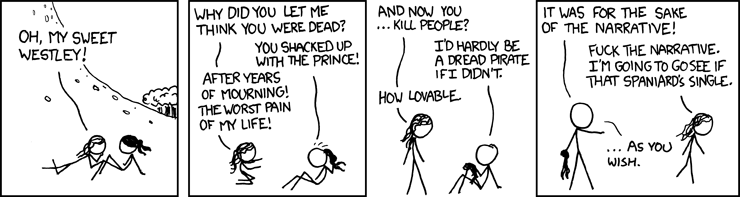
(c) xkcd
The second is a bit more personal - it is the best description (in humorous terms, of course) of my days in Bristol, and a lot of my time since.
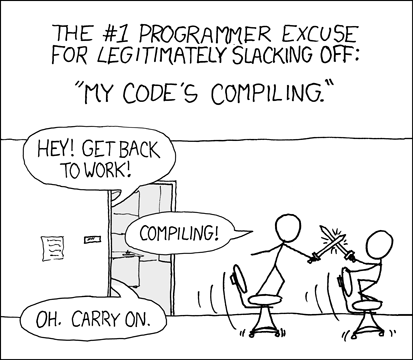
(c) xkcd
Sunday, 1 March 2009
Gun Crazy (1950)
As I watched "Gun Crazy" this afternoon at the BFI, inside my head I kept repeating "the female of the species is deadlier than the male". Peggy Cummins performance of a Bonnie-type character (as in Bonnie and Clyde) is one of the deadliest by an actress in any film noir, or any film for that matter. I think she's up there with Bette Davis (The Letter), Barbara Stanwyck (Double Indemnity) and Kathleen Turner (Body Heat). At moments, she's probably better than all three. She's sexy, manipulative, ruthless, scary, scared. But she's also in love with John Dall's character - or at least, charged with lust and desire - although she twists him at will.
For those who think that classic Hollywood only produced MGM-esque type of films, this, like "White Heat" are pretty good counter examples. The pace is incredibly fast, the script is tight, and although at moments you can see that the budget was not very large, they don't come often. As the 1940s ended, both films look back and project all things to come. The programme notes, mentioned this as one of the inspirations behind 1968's "Bonnie and Clyde". As I haven't seen that I can't comment, but I honestly wouldn't be surprised. It is really increadbly powerful. The only flaw I could find was Victor Young's music, which was too Max Steiner and inappropriate. At times it really reminded me of Max's score for "Now, Voyager".
If you're in London, go down to the BFI and take a look. It'll be on until mid-March as one of their extended runs.
For those who think that classic Hollywood only produced MGM-esque type of films, this, like "White Heat" are pretty good counter examples. The pace is incredibly fast, the script is tight, and although at moments you can see that the budget was not very large, they don't come often. As the 1940s ended, both films look back and project all things to come. The programme notes, mentioned this as one of the inspirations behind 1968's "Bonnie and Clyde". As I haven't seen that I can't comment, but I honestly wouldn't be surprised. It is really increadbly powerful. The only flaw I could find was Victor Young's music, which was too Max Steiner and inappropriate. At times it really reminded me of Max's score for "Now, Voyager".
If you're in London, go down to the BFI and take a look. It'll be on until mid-March as one of their extended runs.
Subscribe to:
Posts (Atom)